
The Body Beyond the Body
Signal, Coherence, and the Search for a Theory of Remote Systems Insight

Introduction: A Dog, a Question, and an Unexpected Observation
It started, as these things sometimes do, with a dog.
At our house there is no predictable schedule. My son Finn comes and goes at irregular hours. Some days he leaves for ten minutes. Other days he disappears for half the day. No one at home knows exactly when he will return.
Yet our dog often does.
Many times I have watched him suddenly become alert, move toward the door, and begin displaying unmistakable anticipation several minutes before Finn arrives. There are no obvious auditory cues. No established routine. No text message announcing his return.
After witnessing this repeatedly, I began checking my phone whenever the dog became excited.
More often than chance would suggest, Finn was indeed on his way home.
Years later I discovered that similar observations had inspired the work of biologist Rupert Sheldrake. In his studies of dogs anticipating the return of their owners, he documented examples that appeared difficult to explain through ordinary sensory cues alone.
Whether one ultimately accepts Sheldrake’s conclusions or not, the larger question remains:
How much of biological communication occurs outside our current models?
That question sits at the center of a growing collection of observations spanning animal behavior, biofield research, consciousness studies, and my own clinical experience with Remote Systems Insight (RSI).
This essay explores that question.
Not as proof.
Not as dogma.
But as an invitation to consider what kind of world would have to exist for these observations to make sense.
Part I: The Body as a Communication Network
One of the most important developments in modern medicine has occurred quietly.
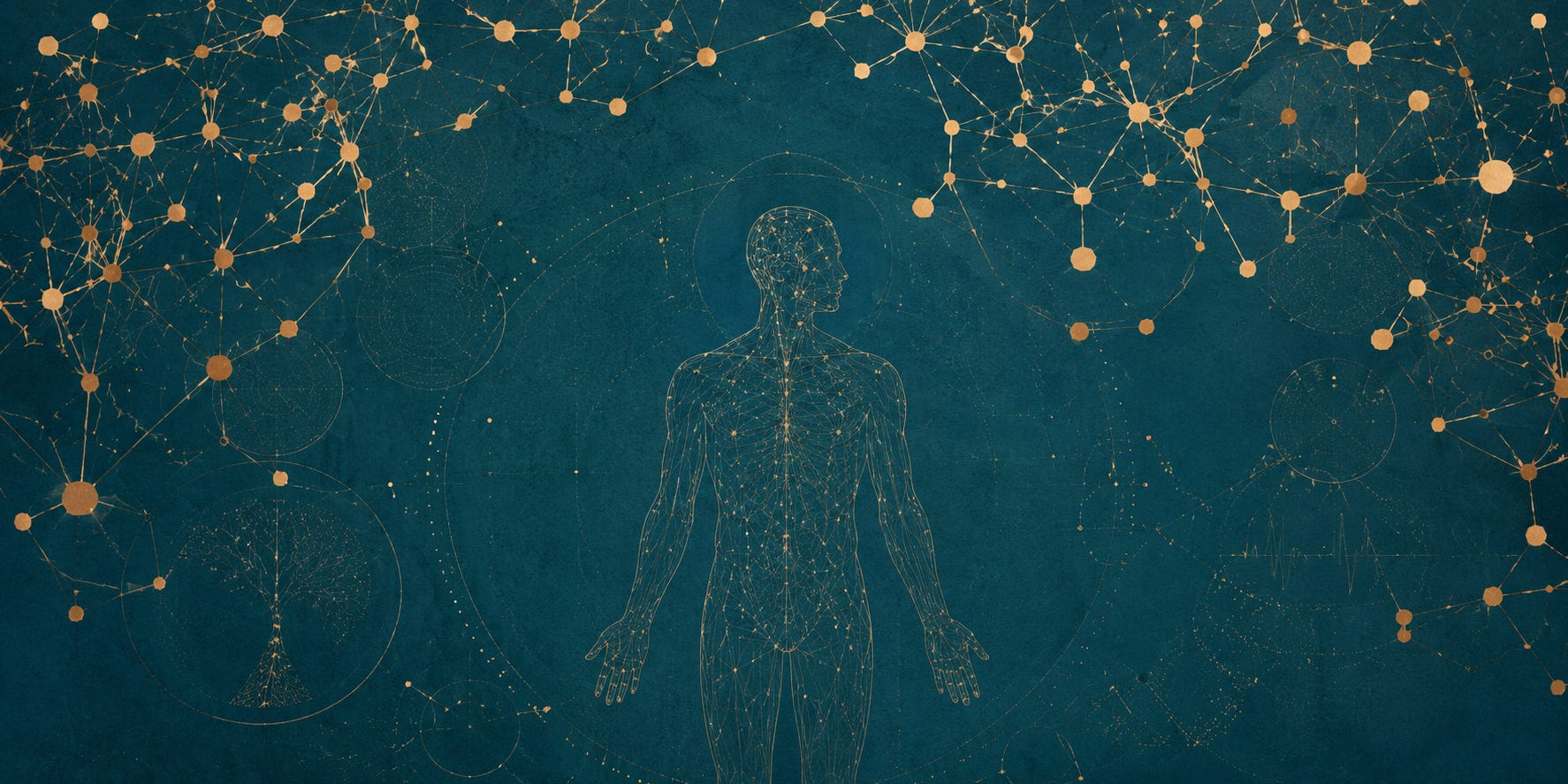
Engineers have begun describing the body in the language of communication systems.
The IEEE 802.15.6 Wireless Body Area Network standard formalizes the concept of multiple sensors communicating across and through the body.
Medical Body Area Networks (MBANs) now transmit physiological information through distributed networks of wearable devices.
The emerging Internet of Bodies expands this concept even further, envisioning humans as participants in increasingly connected information ecosystems.
What is remarkable is not the technology itself.
It is the underlying assumption.
The body is being treated as a network.
Signals move.
Information flows.
Nodes communicate.
Bandwidth matters.
Noise interferes.
Coherence determines reliability.
These are no longer metaphors.
They are engineering principles.
And yet these systems measure only a fraction of what biological systems appear capable of doing.
Part II: TerraNexus and the Architecture of Portals
The TerraNexus framework begins with a simple observation:
Certain locations within the human system appear to function as stable informational access points.
Traditionally these locations were mapped as acupuncture points.
Within TerraNexus they are understood differently.
They function as portals.
A portal is not merely a physical location.
It is an informational coordinate.
Each portal appears to correspond with specific regulatory patterns, physiological functions, and characteristic distortions.
Taken together they form an atlas of organized access points into the body’s broader communication architecture.
In practice these portals behave less like switches and more like addresses.
When attention is directed toward a portal, information associated with that regulatory domain often becomes available through reflexive biofeedback.
The question is not whether the portal exists anatomically.
The question is why information associated with that portal appears accessible at all.
Part III: The Challenge of Remote Access
The most controversial aspect of RSI is not the portal system itself.
It is the observation that meaningful information often appears accessible even when the patient is not physically present.
For three decades I have used structured biofeedback methods to evaluate individuals located hundreds or thousands of miles away.
The consistency of certain findings has forced me to confront a difficult question:
What exactly is happening?
Several possibilities exist.
The simplest explanation would be coincidence.
Yet repeated confirmations, follow-up evaluations, and long-term clinical observations suggest something more structured may be occurring.
The challenge is not merely whether remote information gathering occurs.
The challenge is understanding how it might occur.
Part IV: Three Possible Explanatory Models
Model One: Morphic Resonance
Rupert Sheldrake proposed that biological systems are organized by morphic fields.
These fields carry memory, influence development, and connect members of organized systems through resonance.
Within this framework, practitioner and patient participate in an informational field that extends beyond ordinary physical proximity.
Directed attention acts as a tuning mechanism.
Information becomes available because resonance occurs within a shared field.
This model provides a coherent explanation for many reported non-local phenomena.
Its weakness is that the underlying mechanism remains speculative and is not widely accepted within mainstream science.
Model Two: Information Fields and Network Theory
A second possibility emerges from modern systems theory.
Biological systems may be fundamentally informational.
The body is not simply biochemical.
It is communicative.
It is networked.
It is hierarchical.
The TerraNexus portal system may represent naturally occurring informational nodes within a larger communication architecture.
From this perspective the body becomes less like a machine and more like an adaptive information-processing network.
This model explains why portals might exist.
It does not fully explain why distance appears irrelevant.
Model Three: Pattern Resolution Through Consciousness
A third possibility shifts attention away from transmission and toward perception.
Perhaps RSI does not involve information traveling from patient to practitioner at all.
Perhaps it functions as a process of pattern resolution.
The practitioner enters a constrained informational framework.
Specific questions are asked.
Binary feedback narrows possibilities.
Coherent patterns emerge.
In this model the practitioner is not receiving signals.
The practitioner is resolving structure.
Remote access becomes less like radar and more like navigation.
This model aligns closely with how RSI often feels in actual clinical practice.
Part V: Signal, Noise, Bandwidth, and Coherence
Despite their differences, all three models converge on a common set of concepts.
Signal.
Noise.
Bandwidth.
Resonance.
Tuning.
Coherence.
In engineering, signal-to-noise ratio determines whether information can be extracted from a communication channel.
The same principle may apply biologically.
Every living system produces enormous quantities of information.
Only a small fraction rises above the noise.
Health may therefore be understood as increasing coherence.
Disease may represent fragmentation of coherence.
The clinical task becomes identifying which signals matter most.
RSI can be viewed as an attempt to improve signal-to-noise ratio within a complex biological network.
The portals provide the addresses.
Attention provides the tuning.
Coherence determines what becomes readable.
Part VI: Quantum Biology and the Limits of Current Models
The emerging field of quantum biology demonstrates that living systems often operate in ways that challenge purely classical explanations.
Photosynthesis, enzyme dynamics, and cellular signaling reveal levels of complexity once considered impossible.
Yet quantum biology does not currently explain remote testing.
Nor should it be used as a shortcut explanation.
Instead it serves as a reminder that biology remains more mysterious than our current models often acknowledge.
The lesson is humility.
History repeatedly shows that scientific understanding expands when observations are taken seriously before mechanisms are fully understood.
Part VII: A Working Hypothesis
After decades of clinical observation, I believe the most productive working hypothesis is neither purely mechanistic nor purely mystical.
The body appears to function as a networked informational system.
Certain locations within that system behave as stable informational nodes.
Directed attention appears capable of interacting with those nodes in ways that are not fully explained by conventional models.
Whether the underlying mechanism ultimately proves to involve morphic resonance, non-local informational fields, consciousness-based pattern resolution, or some combination thereof remains an open question.
What is not an open question is the observation itself.
Biological systems often behave as though information is available through channels not yet fully described by contemporary science.
The purpose of inquiry is not to defend a conclusion.
It is to remain honest about what has been observed while remaining humble about what remains unknown.
Conclusion
The future of medicine will undoubtedly involve better sensors, larger datasets, and increasingly sophisticated forms of measurement.
But measurement alone does not create understanding.
Information must be organized.
Signals must be distinguished from noise.
Coherence must be recognized.
Meaning must emerge from data.
Whether viewed through the lens of morphic fields, information networks, consciousness studies, or systems theory, the same possibility continues to appear:
Living systems may be connected in ways we do not yet fully understand.
The question is no longer whether that possibility deserves investigation.
The question is how much we are willing to learn from the observations already in front of us.
References
Morphic Resonance & Sheldrake
Sheldrake, R. (1999). Dogs That Know When Their Owners Are Coming Home: And Other Unexplained Powers of Animals. Three Rivers Press. (Revised edition, 2011).
Sheldrake, R., & Smart, P. (2000). “A dog that seems to know when his owner is coming home: Videotaped experiments and observations.” Journal of Scientific Exploration, 14(2), 233–255.
Sheldrake, R. (n.d.). Morphic Resonance and Morphic Fields: An Introduction.
Sheldrake, R. (2006). “Morphic Fields.” Network Review (Winter), 33–35.
Sheldrake, R. (2019). “Can Morphic Fields Help Explain Telepathy and the Sense of Being Stared At?” Mindfield Bulletin, 11(1), 26–33.
Biofield Science
Rubik, B., Muehsam, D., Hammerschlag, R., & Jain, S. (2015). “Biofield Science and Healing: History, Terminology, and Concepts.” Global Advances in Health and Medicine, 4(Suppl), 8–14.
Consciousness & Extended Mind
Clark, A., & Chalmers, D. (1998). “The Extended Mind.” Analysis, 58(1), 7–19.
Distant Intention Research
Radin, D., Schlitz, M., & Baur, C. (2015). “Distant Healing Intention Therapies: An Overview of the Scientific Evidence.” Global Advances in Health and Medicine, 4(Suppl), 67–71.
Roe, C. A., Sonnex, C., & Roxburgh, E. C. (2015). “Two Meta-Analyses of Noncontact Healing Studies.” Explore: The Journal of Science and Healing, 11(1), 11–23.
Network & Information Theory
IEEE. (2012). IEEE Standard for Local and Metropolitan Area Networks—Part 15.6: Wireless Body Area Networks (WBAN). IEEE Std 802.15.6-2012.
Federal Communications Commission. (2012). Amendment of the Commission’s Rules to Allocate Spectrum for Medical Body Area Network (MBAN) Devices (ET Docket No. 12-124; FCC 12-135).